
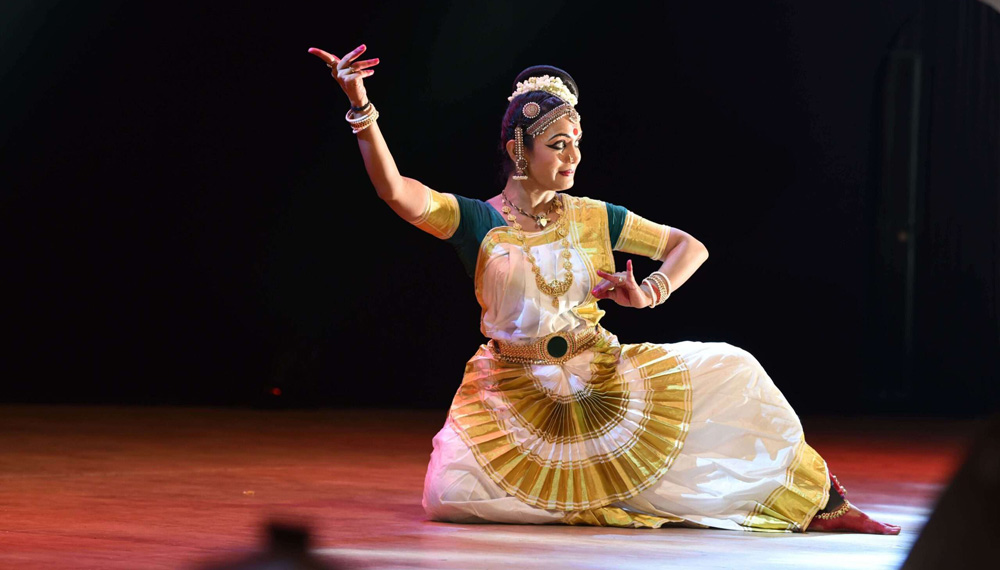
There are various versions of history regarding the origin and development of the art form. Some mention the dance form’s origin can be traced to the incarnation of Hindu God Vishnu as a beautiful female Mohini, who danced to persuade the demons (Asuras). However, these versions merely provide a mythical background to the art form by considering the word meaning, and there is no clear evidence to connect the art form to its mythical origin. Some versions find Mohiniyattam’s roots in the ancient temple dance culture prevalent in different parts of India. The dancing girls in the Kerala region, known as Thevadichi (servants of the God) and Thali Naga (Women of the Temple), are considered the ancestors of the dance form. This version connects the dance history with the prevalent temple dance culture of South India, mainly in the Tamil Nadu region, called the Devadasi system. In the Devadasi system, young girls were ritually married to the deity and spent their entire lives serving the Lord, performing dance and music, and handling various ritual practices in temples. Researchers suggest that in the Kerala region, some temples had this system of dancing girls, which is where they find the roots of Mohiniyattam. Dancing sculptures in temples and mural paintings of dancing ladies mark the presence of a female dance tradition associated with temples.
Another version of history states that the present-day Kerala region did not have a temple dance culture like that of the neighbouring state of Tamil Nadu. Instead, the female dancing tradition was prevalent as an entertainment form rather than a ritualistic one, and dance performances were arranged for patrons and the privileged wealthy class to enjoy. Scholars highlighting the prevalent culture of Goddess worship in Kerala find that the system of marrying the deity and living in temple was not a part of Kerala’s culture. Instead, dancers travelled from place to place to give performances, and it was not a family lineage.
Mohiniyattam grew into a codified structured form under the patronage of Maharaja Swati Thirunal- the King of Travancore (South of Kerala with the Capital at Trivandrum) in the 19th century with the help of Tamil Nattuvanars (dance teacher and composers) and dancers. The roots of present-day Mohiniyattam can be traced back to the dance tradition nurtured by King Swathi Thirunal. After his period, the dance form was popular only in central Kerala, as one of the king’s court musicians and composers, Palakkad Parameshwara Bhagavathar, returned to his homeland near Palakkad in central Kerala and began training young girls. During the institutionalized training for art forms as part of Nationalist movements, Mohiniyattam received its revival at the institution Kerala Kalamandalam under the patronage of poet Vallathole Narayana Menon. Later, from the mid-twentieth century, Mohiniyattam has been accepted as one of the major art forms of Kerala.