
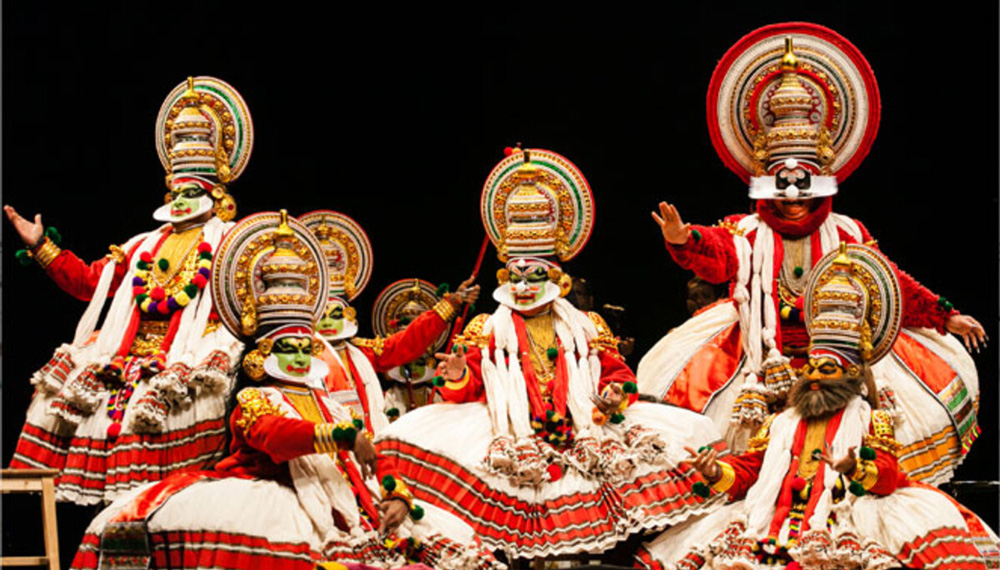
Kerala’s classical art traditions are renowned worldwide, standing as a source of pride for the region. Among these traditions, Kathakali holds a special place as an icon of Kerala’s rich cultural heritage. Kathakali is celebrated for its deep aesthetic nuances, intricate performance techniques, and clearly defined training and presentation patterns. Kathakali is a dance-drama tradition originating from Kerala that showcases stylised acting techniques through detailed hand gestures and intricate facial expressions. The dance elements are equally prominent in Kathakali, that supported by a unique musical tradition that enhances its expressive communication. Each aspect of Kathakali-dance, expression, costume, and music-is distinct, and contribute to its highly stylised presentation, which demands extensive training to master. In Malayalam, “Katha” means story, and “Kali” means play, so the term interprets as a play or storytelling art. However, Kathakali is much more than mere storytelling, as a profound and elaborate art form.
Origin and Development
Kathakali is believed to have evolved in Kerala in the 17th century. Its precursor, Ramanattam, was created by the King of Kottarakkara, a region in South Kerala, to present the Ramayana (Hindu epic stories) as stylised drama pattern. There are differing historical opinions regarding the origins of Ramanattam: some suggest it was inspired by Krishnanattam, a dance drama depicting the stories of Krishna that patronised by the Samoothiri/Zamorins royal family in North Kerala. Conversely, some researchers argue that Ramanattam predates Krishnanattam. Regardless, Kathakali finds its roots in the Ramayana-based Ramanattam, which was initially performed in royal courts and later refined into the highly codified art form known as Kathakali.
The further development of Kathakali is linked to the royal family of Kottayam/Vettathunadu, a region in old Malabar near present-day Kannur. The King of Kottayam, Kottayathu Thampuran, composed four major works for Kathakali: Kirmeeravadham, Bakavadham, Nivathakavacha Kalakeyavadham, and Kalyanasougandhikam. These works, based on stories from the Mahabharata (another Hindu epic) known as ‘Kottayam Kathakali’ on which Kathakali finds its foundation in choreography, text and performance system.
In the 18th century, Kathakali was further refined by Kaplingadu Narayanan Namboothiri, an aesthete who contributed significantly to its development, which style is later renowned as Kaplingadan style of Kathakali. The art form began to flourish again in South and Central Kerala, with regional rulers, royal families, and Namboothiri families (Mana) patronising Kathakali by organising performances and establishing training centres. A pivotal figure in the 20th century- Pattikamthodi Ravunni Menon, played a crucial role in codifying Kathakali’s scattered systems. Olappamanna Mana (a Namboothiri – Kerala Brahmin family) in the Village Vellinezhi played a major role in promoting Kathakali training. The style that follows a codified system in presenting both dance and dramatic aspects of kathakali that was designed by Pattikkamthodi Ravunni Menon and later flourished through his disciples is known as ‘Kalluvazhi chitta (style)’ of Kathakali. The continuous evolution of Kathakali found a complete shelter and refinement with the Kerala Kalamandalam – a prestigious institution for art and culture.