
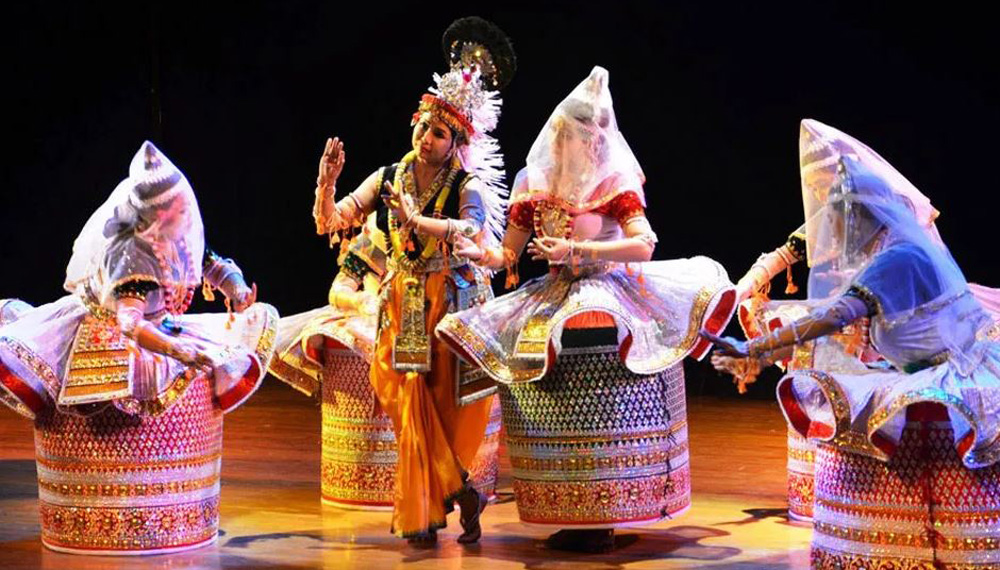
The tiny northeast Indian state of Manipur has a rich theatrical legacy that preserves both later “classical” forms and archaic and animistic ones. The dance-oriented forms of Manipur have developed independently and have managed to maintain their distinct identity and essence to this day.
The first reliably dated written texts describing Manipuri dance date back to the early 18th century.
The origins of Manipuri dance can be traced back to ancient times, even before recorded history.
Lai Haraoba, the earliest form of dance in Manipur, is still celebrated as a festival in the state and has its roots in Manipur’s pre-Vaishnavite era. Its literal meaning is “the merrymaking of the gods,” and the chief performers are the priests and priestesses known as maibas and maibis.
Manipuri culture is a blend of Indian and southeastern cultures, which is reflected in its dances. The classical Manipuri dance has two divisions: Jagoi, which is predominant in Ras Leela and represents the Lasya element, and Cholom, representing the Tandava form of classical dance. The dance streams are independent of each other, and artists typically specialize in one or the other throughout their lives.
The central themes of Manipuri dance are the love stories of Krishna and Radha, although other themes are also showcased. The chief instruments used in Manipuri dance are the drum and the flute.
Hinduism is deeply ingrained in Manipur’s ancient belief system and the civilization it produced. The rich dance heritage reflects this, with Hindu themes performed distinctively indigenously. At the same time, certain dances still have a direct connection to the Sanamahi religion and its rites and ceremonies.